


That’s the last line of the
Waste Land, of course. It will serve us as a beginning rubric. As a
reminder that the best of us have been looking for answers outside our
own culture, the culture of the West, some 80-odd years it’s been
now.
When something troubling happens, and doesn’t go away, I will look to a friend, usually, and apply for some advice. That’s what I did after the rape of the Baghdad Museum. I forgot to say that nowadays I do a lot of re-reading, and at the time I was having another try with Thomas Carlyle’s Sartor Resartus and the same author’s essay on Heroes. You should read again the stuff you read early-for the changes in you’s sake. Anyway, “all deep things are song”, I read, and “the Poet has an infinitude in him: communicates an Unendlichkeit…to whatsoever he delineates.” I went straight to Raffael.
Joseph, however, would not answer my question. I tried again. “Whadda we do when they bring it here?” I wanted to know. “Blow up the Frick?” J.R. was impassive. After a while, he offered his own question: What happened in the Dark Ages?
I was relieved. That’s right. They took it all into the monasteries.
Joseph has been giving that Monasteries answer for a long time. The guy is a Monk manqué. But he may be right! Raffael Roshi, I would call him, if I dared.
Read it in Health
<> Rereading Wolfflin as I’m wont to do I am liable to fall into a reverie where all current art slides into a pendular model, back and forth, from a stark precisionist classical order to a lush Romantic passionate realm of feeling, a mystic cloud of Unknowing hospitable to the art of Joseph Raffael.The true artist for me, is not the classical artist who measures Reality and clarifies it but the break thru Romantic who carries all before him and sails toward an undiscovered shore.
Fauvism over analytic Cubism, then. Goya over David. Monet over Gerome. Rembrandt over all the field. In this permanent confrontation I incline to the Romantic. Always have.
Joseph’s paintings are Awesome.
To understand what Raffael is doing in the recent huge watercolors requires no special apparatus.
You might want to oil your brain a little because if you are at all like me, parts of it unaccustomed to use are likely to come into play.
By the happiest of happenstances the first time I laid eyes on the painter Joseph Raffael--(But here I must step in right away to caution those unfortunates who, mind-set against the Marvelous,
may be planning to just riffle thru this text and 'lookit' the pitchers. Come, come, Pobrecitos, you're the readers I want. No longueurs like preaching to the converted.)
Very well. The first glimpse I got of Joe Raffaele, as the painter Joseph Raffael was known in those days happened to happen on the same bright late Fall afternoon....
(But a second thought chills: The reader has read thousands, {well hundreds} of essays on contemporary art.
Virtually all these pieces begin at the beginning and accelerate onward. We have too much respect for our reader to do him that way.
If the reader wants to enter our world in medias res, we shall oblige him, asking only that the upcoming cliché be indulged).
What goes around, comes around. At least this is so in our field. At length, at long length after growing up three decades out of the limelight, Photorealism is about to be re-appreciated.
Well, a lot of us wouldn't mind being 30 again. Excepting Raffael and Chuck Close, the ones that head up my all-star cast depend on neo-classical stratagems: the way Bob Bechtle plants a figure before a car in front of a house; the way Dick McLean stations a horse and rider in front of a shed-row building; the way Ralph Goings "captures" a diner customer within interior geometries.
Everything depends on carefully articulated planar recession, clean transitions, reciprocating part to whole composition. Meanwhile Close and Raffael have their own dependencies, "Romantic" ones. Of major significance here is the idea (it can most readily be extrapolated from Chuck Close's early portraits of Friends) that Friendship is a main Content of Art.
But the most important tactic these "romantics" share is the use of greatly inflated single images in order to stun the viewer into a temporary state of Awe.
Brought up to your eye-level, a l'Audobon, a humongous Frog, an immense Owl confront you. The symbolic value of these messages (Metamorphosis/Wisdom) isn't negligible.
Yet what's mainly at stake here is the proposition that Scale is Content. Can be anyway.
And it can be that technique is Content, too, as I observed in my Laguna Beach catalog a propos of Joseph's work back in '81.
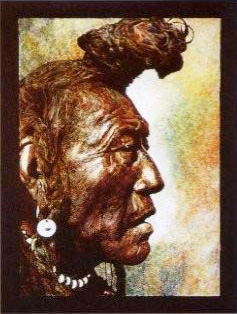
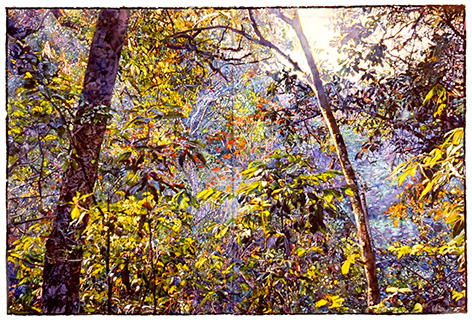
Beyond this there's something special about Joseph's paintings, from the great Indian Heads of the late 60s all the way to his recent watercolors like Friendship's Forest
 |
 |
|
| Blackfoot, 1970 Oil on canvas, 80 x 61 in. (203.2 x 154.9 cm) Joselyn Art Museum, Omaha, Nebraska |
Friendship's Forest, 2002 Watercolor on paper, 56 x 83 in. (142.2 x 210.8 cm) Private Collection |
|
(with its direct nod at our mutual friend Steve Kaltenbach's Stoned Maple, 1973.
That specialness has to do with the fact that any major Raffael will serve to vindicate Andre Breton's early Surrealist dictum that "Only the Marvelous is Beautiful."
Which is not true of the paintings of Bechtle or Estes, or any of the Photorealists whose work reworks Neo-classicism.
In Raffael we can see that only the Marvelous is Beautiful. And as you or I or we and even "they" think through it, it becomes clear that Breton's apercu is anticipated in Burke.
As the tinkle, tinkle Papa Hayden Neoclassicism of his own era flagged, and Romanticism geared up to roar by like Beethoven,
Burke located the Sublime at the crossroads of the Beautiful and the Awesome. Raffael takes his stand at this intersection, and has stayed there from about the time he traded Joe for Joseph.
Some years back, now--when Joseph was still working in oil, the local Museum (the Crocker it's called) purchased a large painting of a hydrangea.
Against an incomparably rich black surround, against a velvety blackness in which every color seems to sleep, the huge flower looms at us up close and personal,
the way Raffael likes to stick it in your face.
The immense blossom, moreover is half brilliant blue, and half delicious pink. In other words the hydrangea stands in for Joseph, for you, for me, for all of us which art Spirit intermingled with Flesh. And the cosmic black foil represents the Before we came from and the After which is our destination. The remarkable bloom, half blue, half pink? Well, it's one of Nature's marvels,
a small marvel perhaps, but still marvelous enough to serve Joseph's purpose...nothing particularly fancy is involved: just force-fertilize the plant with iron and the bicolored flower will result.
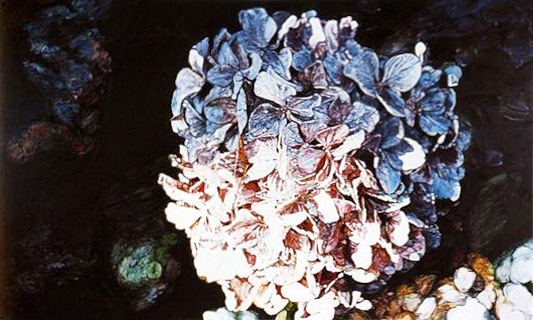 |
Hydrangea, 1976 Oil on canvas, 66 x108 in. (167.6 x 274.2 cm) Crocker Art Museum, Sacramento, California |
Understand this "marvelous" painting and all the rest of Raffael's artistic achievment will fall into place.
The Museum installed Hydrangea in the lavish ballroom where one person who failed to understand it--or rather understood it all too well-- was the head of the Crocker Board.
This banker said his sensibilities were offended. WHAT!! I thought when the news got to me on the grapevine. There has to be some sexual angle I'd missed; or was the painting somehow political? Had Joseph, advertently or no, painted something which might cause rich people to feel disenchanted with their lot?
I rushed to the Crocker, eager to see what crime Joseph had committed against the Norms. An anxious Curator writhed before the big hydrangea.
"Mr._____ claims it's too overwhelming!" the Curator whispered, with due pathos. "Too overwhelming...”
I repeated and I gave the painting a hard consider, while the hydrangea continued to stare me down.
What you have to recognize here is that all negative criticism contains a nugget of truth. This is so, even of philistine criticism.
I turned to Patrick and Steve, the Museum roustabouts. "Better stick this one down where the sun don't shine" I said. "Mr.______ is right. This damn thing is too overwhelming!"
Bandy this
Too overwhelming. The giant increase in image size in artists of Close's and Raffael's generation probably owes as much to the narrow influence of the figurative branch of Surrealism as to the more obvious impact of outsize images from the commercial world of billboards ad-graphics and such or from the ever proliferating supericons of the big and little screens.
The aim of Dali, of Magritte, was to break through the routine conscious reality by juxtaposing items which seemingly don't belong together, often at an extreme disparity of scale.
A room-size green apple. A room-filling pink rose. These paintings while they may be scaled large are of a modest dimensionality. Magritte pitched his work at, say, the de Menil townhouse.
Aiming instead at the walls of the Whitney, Close and Raffael, so to speak took the room off the apple.
All the scale Joseph needs was provided by the paying customer wandering the exhibition and pausing before the Raffael.
If we were in the mood to bandy art terms (and often we are) we might want to say that such a visitor was laying him-or-herself open to a dose of the Sublime.
Put another way, said gallery-goer was in grave danger of having an encounter with the too overwhelming an sich.
The gallery-goer, we like to say, the very dear gallery-goer is always right.
I miss an opportunity (I wd've squandered it).
Return we now to that first time I didn't meet Joseph. By a happy trick of Fate my first sighting of Joseph happened to happen on the same bright late Fall afternoon in pumpkinrich,
wear two pair of socks, sure gets dark early New England. The very same October day that I got my first look at Norman Schwarzkopf the General. This was not quite 50 years ago.
I was hurrying under the portcullis, across the little moat-bridge, and quickly to my right along elm-leaf strewn York street headed in the direction of the Art school,
a little late to meet my ride to the Yale Bowl. Joseph was coming toward me in the other direction.
Yes. Raffael, already evidently a grand master of le symbole juste, had, without his being aware of it of course--such is the degree to which Joseph lives in thrall to his unconscious,
managed to simply bowl over this reverse-gear poor pilgrim, symbowled me over spiritually I guess you could say, and left me on the sidewalk as conflicted and confused as this very sentence.
Unlike Paul enroute to Damascus (we do not draw the line at blasphemy when blasphemy suits us) I got right back up on my highhorse, brushed aside all immediate doubt (Huh! whutwuzzat?!?)
and continued onward in my artcritic's direction.
Joseph meanwhile hardly broke stride... He had left his cubbyhole "studio" a few minutes before and was on course for the business block up ahead, no doubt on an art supply mission- Joseph would not be going to the game; or he may've been heading for his cut and paste Bursar's job at the Yalie-Daily.
What is done by computer now, in those days was all scissors work. Sack State, in Raffael's days there, was a veritable play-pen of collage activity.
Jim Nutt based himself in Max Ernst whom he expounded brilliantly; Jimi Suzuki owed more to Schwitters side of Dada: every scrap was grist to his mill.
It would seem that JR got more than a tuition voucher out of his duties mocking up ads.
Elsewhere I have described JR's truly chic collages as "classy" and that is undoubtedly the word for them.
More importantly, Joseph's commercial work provided him a foundation for his decision to break away from the artist mob and begin to make paintings based on photographs.
The paintings, that is, which first brought Joe Raffaele to major attention: vignetted photographs on an all-over white ground, paintings that could be considered to be "commercials" for Love, Compassion, and a greater role for the Sacred in our lives. From this position JR's work has never strayed. Raffael went his way, I went mine, New Haven regained its normalcy.
And an instant of enlightened revelation, of distinctly spiritual exposure, with concomitant Pain, was translated back to the realm of the Ordinary.
There had occurred a literally pedestrian encounter, no more. Forget about it. And for nearly 15 years I did.
Let’s stay a bit longer with this episode in which an artist swamps a critic in his wake. For it is a paradigm of experiences you may have had this week or last week or next Thursday.
You find yourself thinking of someone you haven't had in mind for months, for years, for you can't remember how long. And the phone rings, or the post arrives, or you have e-mail.
This coincidence! It's strange. For a moment, you marvel at this freaky conjunction. But it doesn't fit in, it doesn't figure. You soon put it behind you, safely outta mind.
Say you are watching a movie with your near and dearest, the remark she makes at the commercial is the exact thought'd been running silently thru your mind.
This happens to pretty near everyone, although some people are more susceptible than others.
On long trips, once we'd settled into the rhythm of the road, my younger son Tristram and I would slip into virtual front-seat telepathy.
All this of course is mostly a function of the fact that we use so small a portion of our brain's powers.
All’s I really know is, I passed this guy on the street going the other way, and I picked up some sort of psychic communiqué from him, something like “Yer goin’ the wrong way direction, fella”.
More likely it was “Hey! I’m going the right direction, take note!” Was this ‘message’ actually beamed at me?
It’d be silly to suppose so. It was just Joseph, hydroplaning down the central spiritual channel, hob-knobbing with the Platonic Over-soul, humming like a dynamo.
It was Joseph, all right – unless The Graduate School harbored Raffaele’s doppelganger a tall Italian boy, comely as a movie star, and radiant in a way that doesn’t spell Yalie.
For th’apparel oft proclaims the man As for the codes, Joseph was giving mixed signals. Have I mentioned the codes?
They were all-important at this date & place. Joseph Welch had only just squelched Sen.
Joseph McCarthy and the pressure to conform was still in the air breathed by our Joseph Raffael by me and by every other poor soul around us.
That pressure toward uniformity had resulted in a uniform – the Ivy League dress code, and everyone learned it. In this context Joseph revealed himself as an evidently amphibious creature from the Graduate depths: He wore a regulation Harris tweed three button jacket with elbow patches over a crewneck wool sweater plus a solid color scarf, no hat, no gloves.
But he had on dungarees, black dungarees with paint on them. Black shoes, too and these also encrusted with oil paint.
This rather mythic apparition was half Code Ivy and half Code Boheme. He’s got them on a list
During Joe Raffaele’s residency – and for at least 20 years after Joseph’s matriculation – the Yale Art School was the best in the world.
More notable artists came out of Yale than the combined total of grads for the Chicago Art Institute, K.C.I., Cal School of Fine Arts/SFAI, Chouinard, plus Otis plus UCLA/USC, an’ name a few more (but don’t name Berkeley).
A few of these Yale Masters in Art, besides Joe and Chuck, were Eva Hesse, Robert and Sylvia Mangold, Brice Marden, Audrey Flack, Louisa Chase, Richard Serra, Jon Borowski, Rackstraw Downes, Jennifer Bartlett, William Bailey, Martin Puryear, Judy Pfaff, Nancy Graves.
And more, more, more. How’d this all happen? Well Yale decided to take a chance; often that’s how you get on the right side of Luck. Harvard said they too wanted a hands-on art dept.
But they didn’t mean it. Le Corbusier was asked to do the building; and he delivered a jewel-box of the Harvard-specified proportions.
The building is in itself a work of art. But who could let go in such a dollhouse? The pretty little thing was way too small.
The truth is, Harvard didn’t want a lot of kids with paint on their shoes making the Yard untidy.
So, when one thinks of good artists who’ve emerged from Harvard, George Tooker comes to mind, and Willard Midgette…conservative painters those two and trying to think here…nope, ‘fraid not. And, come to think, weren’t those guys undergraduates? Like Oldenburg and Michael Mazur and Matthew Barney at Yale? Anyway Yale had JR, and Neil Welliver, Don Nice, too,
and eventually they would have Maya Lin. The most important teacher for Joe Raffaele was also the most consequential in art world terms. So often this is the case. The teacher who in the long run is going to mean the most to you is the one who gave you the most to go on or the most to go up against. You pass him in the corridor.
That was der Alte! Mein Gott! The passageway bristles with challenge and opportunity.
You feel this, or you feel nothing and never will. As for Joseph, his art is almost entirely about having feelings; it teaches you how to have feelings and keep feeling them.
Albers’ paintings are the reverse of “Overwhelming”.
They are never large; mind you, he does not overstep and with nice adjustments he manages to keep the sometimes dead hand of Neo-classicism from lying too heavily upon them.
Did Albers’ color theorizing have a determining influence on Raffael, as it did for so many grad students? Not hardly.
But Albers did lead Joseph to think about color, and one way you could think about JR’s color-employment is as a sort of riposte to Albers’ lucid but frozen tinkering.
Joe did not change his name to Josef.
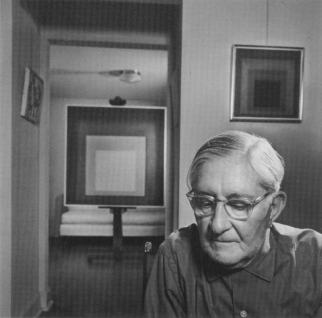 |
Josef Albers |
What about Josef Albers’ color? Well, what about it? I like to remember that before he lucked into the job of youngest Bauhaus instructor Albers was a high school teacher. His art always strikes me as having more than a little whiff of the gymnasia . Albers comes into the room. The colorkids stand to attention and click their heels. Good morning, Herr Professor! Guten Morgen, boys. Herr von Ochre, you vill go to the corner. Herr Turquoise, you vill kindly move your seat between Herr White and Herr Black. Alizarin Crimson! Do you so soon forget? I forbade you to sit next to das Kleine Viridian. (Taking a 3’ruler from beneath his coat) Hmmmm, hmmmmm, hmmmm. (glances at roll-card) I see Herr Yellow has accompanied that hyperactive Magenta to the sweets-shop again. When will you children learn to follow simple rules? And so forth. This is not to say that Albers’ paintings do not serve German philosophical Idealism, nor that they do not supply a fitting memorial – they are like gravestones, really – to a German sense of Order. It is just that they provide an absolute foil to the intensely felt Italianate passion that informs every painting of Raffael’s. Art history shifts around more than it actually changes. It’s Italia ed Germania redux.
 |
Concord from the suite Die, Josef Albers 1965 |
One great thing about Albers is he never let on. He got the painting down to a single variable – color.
But once he’d arrived at his signature format of squares within squares within squares, he avoided every eccentricity, every temptation to play around.
His work offers a kind of ne plus ultra of neo Classical balance and restraint. It makes Agnes Martin appear, if not a loose woman, at least a giddy girl…If this were all, Albers would not be the great artist that I think he was. But there is something additional.
In a radio broadcast (KPFA_ Pacifica) of 1968 I hypothesized that for Albers the crucial event in his career was a small-plane flight over the temples in Yucatan and Guatemala.
He looked directly down at these sacred structures, newly relieved of their concealing mantle of jungle flora.
The revelation was complete. Moreover he was the first artist of merit to see this aerial view of the temple sites-sights.
We’re not talking here about the familiar to everybody world of Egyptian monuments, like the stepped-pyramid of Zoser.
Monuments, that is, eroded of their spiritual presence by centuries of tourism. The Mexican pyramids allowed Albers a fresh spiritual vision.
Albers looked thru the viewfinder of his accordion-camera straight down at these holy accordion-temples, and lo! he’d found his image.
Both at Cooper Union and at Yale Raffael met up with teachers he respected and loved, and gained from, teachers who cherished him in return.
From Albers he learned standards but the little old man didn’t appear to like him and took little notice. Joseph didn’t –like-back.
I have nevertheless formed the impression that Albers must have been one helluva instructor.
Consider someone who knew Joe Raffaele slightly in the New York milieu of the late 50s: Robert Rauschenberg.
Bob R. studied with Albers at Black Mountain where they cordially dis-admired each other. Bob Rauschenberg was, and is, messy.
Also he didn’t cotton to the idea that paintings should be “about” the impact of adjacent colors on each other.
Along with Johns and Warhol and Rosenquist and the still a small-fry JR, Rauschenberg thought a painting ought to be able to accommodate a little more Daily News.
But before he got around to his montages of the news of the day, Bob R. offered New York three one-man shows: All-white paintings; all black paintings, all red paintings.
No color in other words because the red paintings were not about hue, they were about Blood and dirty blood at that. Bob was just showing the world how much influence the master color-theorist had on a boy from ‘Lass Picher Show’, Texas. Yet if you ask Rauschenberg who meant something to him as a teacher, he will tell you: Albers. Raffael’s situation was not dissimilar.
He repaid Albers by unlocking (in Forest, for example) the treasure chest of Color and taking it on spendthrift flights of inspiration.
This is an ongoing trip or process, tho’ its hard to imagine where color can go after the freedom of Passage or the thrice scintillating Pond.
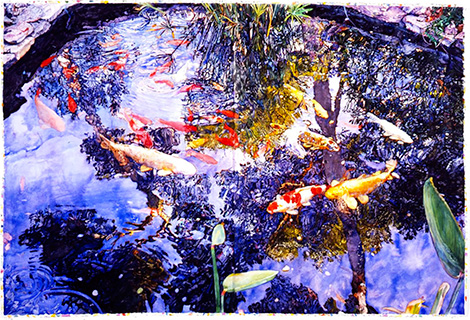 |
Pond, 2002 Watercolor on paper, 54 ½ x 81 in. (138.4 x 205.8 cm) Private Collection |
The critic however, rarely sees what the Future holds. Should Joseph fail to surprise me it will be a surprise in its own right. And another Surprise.
Corroboration for Albers’ high pedagogical capacities comes from a surprising source: My old pal Franklin P. Conlan.
From preppie days (Groton) Hank apparently displayed a water witching ability to locate “gut” courses for his fellowman.
A paragon of self-sacrifice, Hank would take such a course himself to make sure it was safe for others to follow. There were minefields in the Yale of that day, professors who actually insisted you do the reading, etc. Anyway, Hank found a very promising course and duly enrolled in Art 20b, “Basic Color Studies”. J. Albers, instructor and Dept. Head.
Word got around that Conlan was onto a sleeper. The course soon filled with Hank’s lazy Groton and St. Mark’s friends.
What a miscalculation!!! Never in all his life, prior and subsequent, had Conlan worked so hard as under the thumb of the Old German. Conlan adored Albers.
Later he went so far as to buy some work…the true test.
It was from Conlan that I learned that it was OK to have long hair at Yale in that era of codes. I’d met Hank in a French class I’d taken in order to study with Henri Peyre.
Like Albers, Peyre was a part of the European brain-drain to high-salaried U.S. Universities.
Peyre was so far above the usual Yale prof - much less your average Yalie- that he would permit you to fill your bluebook answers on the a la Recherche final, say,
with recipes for Madeleines or for that matter blueberry muffins.
In Berkeley I had been the rich kid on the right block; here I was just a crew-cut auslander, wearing Chinos and argyle socks, I kept the crew-cut for awhile, as I pondered the codes.
One thing that bothered me was the situation with John Hugo Loudon in the dining hall. John Hugo, I learned was a Drama major – suspicious enough right there.
He was a thespian, moreover, who allowed his hair in back to flow over his collar.
Unheard of, unheard of!! Why I asked Conlan, why did not the other boys, when John Hugo sat down at their table, why didn’t they pick up their trays and move to another table?
Why do they seem to enjoy his company? Well, check his London address in the roster, Hank said. He has a trout stream in Scotland…and a castle.
Oh and his father is Board Chairman of Royal Dutch Petrol.
My friend happy-go-lucky Frank Taylor, from Los Angeles, kept his crew-cut and wore his khakis throughout an undergraduate career studded with innumerable practical jokes.
Frank thought Senior Societies were so much piffle.
One Halloween he vaulted the wall behind Skull & Bones and planted thirteen leering jack o’ lanterns; then two more for the front steps.
There was no harm in Frank.
A lot of years separated him from his very sober-sided older brother, Reese Taylor Jr., also a (law school) Yalie and junior partner in my Uncle’s Los Angeles law firm. Reese Sr., was CEO of the Union 76 Oil Co., and not incidentally, good friends with my Dad.
Taylor was charmed by my younger sister and would collar my Dad and Honora for excursions to such inner sancta as the private showroom at I.
Magnin, where models would parade and Honora had her pick of the couture. People look back to the 50s with nostalgia…..a mistake. The 50s were a time, at Yale any way, when you could wear your hair any-which-way you wanted – that is, if your father was head of a major oil company.
Raffael, from a Brooklyn family comfortably off but not wealthy wore his hair long and ‘full” – but not over the collar. While I, taking a good look around me at the trust fund preppies, started to save a little money on haircuts. Meantime Joseph had fallen in love: with the Yale Art Library and its limitless stash of good stuff.
Every minute he was not painting in Street Hall or working, eating, sleeping he spent there reading, reading, reading and turning the fabulous pages of the Library’s hoard of art books.
We must’ve seen each other there occasionally.
Albers I used to see irregularly on York St. and one afternoon he was on the wide steps of the Sterling, deep in German conversation with another professor, as I walked in to do some research.
An hour and a half later I emerged. The two men were still figuring it out.
Albers and …looming over him, Hindemith.
Costly thy habit as thy purse can bear The reader has long caught on that I am trying to set up an analogy between the Yale dress code and the pressures of the me-too Art World where the monkey puts the cap on in Chelsea and before the month is out monkeys the world over are pulling on a nearly identical version.
I always loved it how Louis XIV controlled his fractious nobles by keeping them at Versailles for a continuous round of parties, and requiring them to dress in accordance with his own costume, and which he altered frequently enough to keep them occupied in adding the right number of rosettes to their dance pumps.
Too busy, then, to mount a rebellion. In a recent email Raffael informed me how it was that he could stay in the sartorial swim: “I was wearing clothes from the Goodwill Store on Chapel Street.
I’d go in there at the beginning of the autumn semester and at the end of the school year to collect my clothes. ……What and who we used to call Yalies often left their clothes at the Goodwill rather than have to carry them home…..I also found my ‘winter’ coat one night at the Yale Daily News where I worked as a paste-up artist.
There had been a coat lying there for months on one of the overstuffed and very sat-in chairs.
It was a classy J. Press coat, brownish tweed on one side and reversible grey for rain on the other.
After months of waiting for the guy to claim it, he didn’t and I did.” This of course is Joseph with his funny side up (as it never is in his art).
Unfortunately, it’s absolutely true: Lots of fellows had better things to do than pack up their clothes and send them home.
They didn’t give their stuff away, either-which would have lent an aspect of Charity to the procedure. They just left everything in the closet. And it made its way to the Goodwill.
The grad students generally despised the over privileged, wasteful Yalies who couldn’t be bothered to despise them back.
Of course Joe Raffaele, an Italian Catholic, like 70% of the New Haven populace, may have come in for a little gratuitous prejudice.
Be no surprise as we say in racing circles.
Vernal equinox Had the chance somehow afforded itself, and Joseph had sat down at my table, would I have snubbed him? I think not.
But Joe might’ve walked away in disgust if he’d been there when it was reported to me that a certain classmate, a future major league pitcher,
was overheard telling his girlfriend that “The first day of spring will be the day John Fitz Gibbon puts on his gabardine suit.”
This particular athlete chap was never known to positively declare something original, so there was a good likelihood that the sentiment was in general circulation. Instead of being horrified, mortified, and immediately changing into sack-cloth, hold the ashes, I was generally gratified or, rather, I was like a gratified general, victor in the Code Wars.
This puts us back in mind of Norman Schwarzkopf, left to dangle all this time on the day of my wrong-way Zen encounter with Joe Raffaele.
Schwarzkopf, a corn fed farm boy farm boy, spent his afternoon that Saturday being roughed up by the opposing Yale tackle, Phil Tarasovic from nearby downscale Bridgeport,
in Yale’s 13-7 upset of Army. Tarasovic, tho’ football Captain, was passed over for Skull& Bones; rumor was he had the wrong kind of name.
As for the future General of Armies, he had no code worries whatever. Everything was spelled out for him. To class he wore his cadet uniform.
If he should be roped into taking his roommate’s sister to the Princeton Prom, he would wear his operetta dress-outfit cum sword. On the field he wore his football uniform, with cleats and helmet. His hair cut?…Cut regularly, dear reader, to regulation length. Yet there was some element of free choice even in the conformist era which governed the options for the general, the painter, the art critic. The familiar myth of the judgment of Paris has something to tell us here. The story suggests that each of us is empowered to give his golden apple to the most beautiful of three competing Goddesses: Hera (Wealth), Athena (Power), Aphrodite (Love). This choice is fairly unambiguous for some people, Jacqueline Bouvier, for instance. First she gave her apple to the most powerful man in the world; then to the richest. I rather figured she might end up with an artist: Saul Bellow, maybe; or Frank Sinatra. But for her the myth ran out of fuel. In the eye of the beholder
Norman Schwarzkopf gave his apple to the Warrior- Goddess of military strategy. That’s a Greek word, strategos; means “General”. He was promised, and got, undying fame, like Alexander’s or Eisenhower’s. Well, long-lasting, anyhow. Cadets don’t take bribes, but he would have given his apple to Athena anyway. She looked way prettier’n the others.
The teen-plutocrats I went to school with already had more money than the reader or the writer but they wanted more, much more. They sent their apples to Hera who’d promised them to exponentially increase their wealth; sent (by private courier) not given personally; no time for that errand; their tailor was coming up to their rooms this morning; for another tape-measure and scissors session on the Special-Cutting suit they’d ordered in a bored moment. What they wanted is what they got, too: Build the Alaska pipeline; head-up IBM or Morgan-Stanley; or Equitable Life; or perhaps just slip into Dad’s loafers at the Exchange. My class-mate friends worth $10, 20, 30 million in 1956 are burdened with 10 x those amounts today. Hera’s word is golden. There wasn’t a penny’s worth of doubt that Joe Raffaele was going to give his apple to the Goddess of Love and Beauty. It took awhile for the situation to shake down, however. When it did Joseph’s pledge was redeemed in the form of Judith North a former Rose Bowl Princess in waiting and an All-American Beauty by anybody’s criterion. At the time Jane and I first knew her, Judy was separated from Ronnie Davis, the activist-actor (San Francisco Mime troupe), Jane and Judy had met in Marvin Lipofsky’s glassblowing class at Cal Berkeley. Because glassblowing is dramatic, because glassblowing is fun, because Lipofsky is a skilled, popular teacher his class was hugely oversubscribed. For the same reasons (but ostensibly because glassblowing was too craft-centered) the Dept. soon would cancel the position. That Berkeley Art Dept.! Anyway 125 students signed up for a course that could accommodate 15, and Marvin held a lottery. When the results were posted it appeared that the successful applicants were Jane Fitz Gibbon, Judy North, the next dozen best looking girls at Berkeley, and a guy to help Lipofsky to move around the sacks of silica and flux. I’ve always thought of this as an instance of Good Teaching. You could see the value this instructor placed on the principle of Beauty. His commitment to it wasn’t under wraps, you knew where his apple had gone. The joke the gods played on Paris, when Aphrodite promised him the most beautiful girl in the world to be his wife, was that the world’s most beautiful, Helen, already had a husband. This led to some famous trouble. The joke Aphrodite pulled on me, in promising me the most beautiful girl in the world to be my Mrs. is that the woman in question already had a husband…namely me.
I married very early, JR, as he likes to say, “late”. The advent of Judith in his life, the decision to move to the West-coast, his entry into the circle of friends which included William Wiley, William Allan, Carlos Villa and others, his Cassius Clay-like change of name, all betoken a shift in sensibility, a shift in what and how he sees, from fragmentary to unitary, from break-down to wholeness, from suffering and pain to transcendent joy and affirmation. Fortunately from the Pilot Hill point of view, much of the work of Joseph’s Joe period was already in the hands of collectors and museums. The re-born or at least reinvented artist destroyed what he could of it. I’ll say this: it was no mere gesture – this immolation of his beautiful scrupulously painted canvases in which a few photo-images activate each other against a pitiless white ground. The act of self-cancellation is Raffael of the true vine, vintage Raffael. Joseph does not equivocate. One thinks of David Park, hauling his Clyfford-Still period paintings to the Berkeley dump and watching them burn. One thinks back even to Savonarola-delirious Botticelli’s repudiation of pagan Botticelli. The Italian Renaissance? Yes indeed. Sure to supply a touchstone when needed. Michelangelo ought to be Joseph’s man, given their mutual attraction to the Sublime. But no, if you ‘re looking to explain the generoso factor in Raffael, in Raphael lies your best hope. Unlike Michelangelo, Raphael believed that when a Pope told you to do something you didn’t automatically challenge his authority. Rafaelo Sanzio was extremely good looking, with all the natural graces, and the manners of a courtier. He painted 123,000,000 Madonnas, a record which still stands. Rafaelo was so popular at one time that like our Joseph he suffered a name-change and became Raphael to you and to me and to all English speakers everywhere. In the long term, however, taste, fickle as it always will be, began to find Raphael boring. And cloying. Then there were the imitators. And, throughout art history, every time a new classicism reared its head, the jealousies and misreading of other artists. “How they have deceived me!” Thus Ingres, before the Stanze when the pan-European wars died back and he finally realized his Prix de Rome. At any rate there is such a thing in the history of art as a generoso quality, an italianate sweetness which comes from the artist himself and cannot be learned or faked (as in the syrupy grenadine abstractions of a Piero Dorazio or the bittersweet Campari-lite expressionism of a Clemente.) A Raffael like Parrot 2001, signals the true generoso spirit, and this touchstone is everywhere to be found in Joseph’s current exhibition and in fact thru-out his career, passim. You will spot it in I Macchiaoli now and again as well as in the odd Tiepolo, and you don’t have to squint to glimpse the goodly generosity of soul in a Guercino. In recent writings I’ve suggested other touchstones which may apply to Raffael’s art: like the ones provided by Stephen Dedalus or rather by Joyce or rather by Aquinas. “Tria requiuntur” we read in Portrait of the Artist, “integritas, consonantia, claritas”. A watercolor like May 2003, characteristic Joseph painting of blossoms, must read as one thing , must read as a whole separate and distinct from all the rest of the world. To this end (like Seurat, for instance), Raffael has painted in an interior border, a border within the border. He is making sure that we take in the piece as a single thing , not to be confused or conflated with its surroundings. Next (let’s take Passageway , 2003 this time) a painting must (despite its incredible daunting complexity) demonstrate a harmony of all its parts, each part to each and each part to the circumscribing whole.
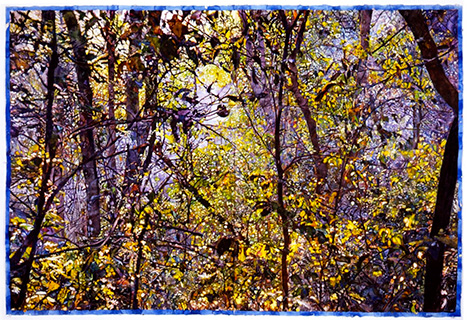 |
Watercolor on paper, 56 x 84 in. (142.2 x 213.3 cm) Private Collection |
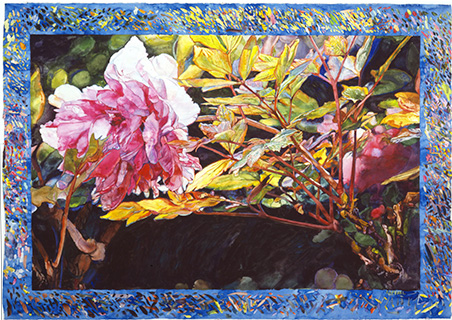 |
Spring, 2003 Watercolor on paper, 44 ¾ x 63 ½ in. (113.7 x 161.3 cm) Private Collection |
The shift to watercolor portended major changes in the personal realm. Joseph and his second wife, Lannis Wood left California for the French Riviera and a series of paintings of Lannis in her garden followed hard upon. The wives or girlfriends of artists have to put up with a lot of modeling but one consolation is that when we ask the question, what were women like in such and thus a country in thus and such a period, the answer comes back, Well of course they were like Mrs. van Rijn or Mrs. Bonnard or perhaps like Mrs. Raffael. This was surely a fine honeymoon gesture (You will read no aspersions on True Love in these pages). Fudging only a little! JR conflates Lannis’ face with Botticelli’s Primavera.
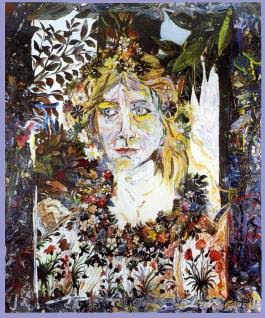 |
Watercolor with acrylic border on paper, 52 ½ x 44 in. (133.3 x 111.7 cm) Private Collection |
only she is still there! Lannis and her garden become one; there is also the consideration that Lannis’ last name is Wood.
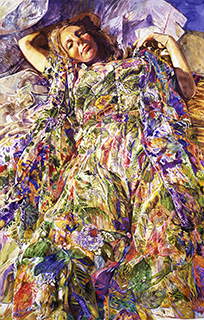 |
Lannis in Sieste X, 1988 Watercolor on paper, 62 ½ x 44 ½ in. (158.7x113 cm) Private Collection |
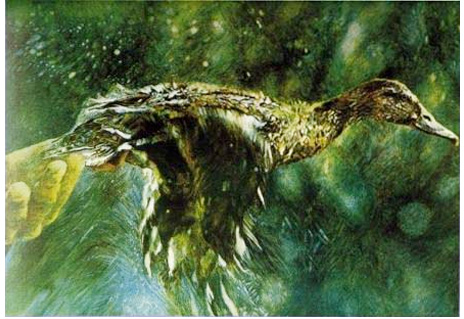 |
Release, 1970 Oil on canvas, 75 x 108 in. (190.4 x 274.2 cm) Joselyn Art Museum, Omaha, Nebraska |
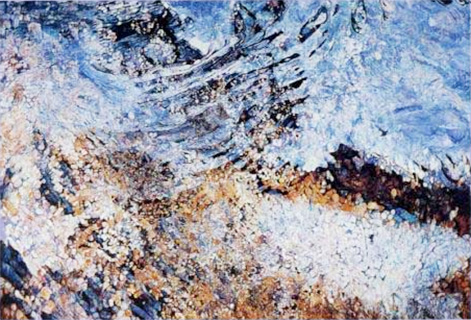 |
Water Painting III, 1973 Oil on canvas, 78 x114 in. (198.1 x 289.5 cm) Jane and John Fitz Gibbon, Pilot Hill, California |
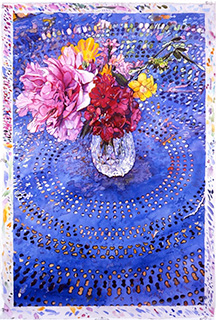 |
Mandala Bouquet, 2003 Watercolor on paper, 21 ½ x 36 ½ in. (54.6 x 92.8 cm) Private Collection |
JR felt in Riley’s piece an immediate affinity with his own work. The experience was one of the motivating factors in his move to the West Coast where such musical soirees do occur, but less frequently let’s admit than in marvelous beautiful N.Y.
Usually I stand up at the opera because it’s affordable and you can sometimes find a seat after the act one intermission. On this occasion, however, we had orchestra seats, the gift of a friend who wasn’t up to Lulu and we enjoyed a splendid performance from close enough to see as well as hear it. We went on to one of the neighborhood halls where Howard Hersh was conducting a midnight concert. “In C” was the main event. Quite a few people from the Opera were there, all keyed up from the gorgeous music.
At the Opera House nearly everyone had been older than we; For the Terry Riley, almost the whole audience was our age or younger. One exception was Alfred Frankenstein, rather silly looking in white tie-short people appear shorter in a tailcoat. I was in black tie while Jane wore a velvet cloak created for her by one of Joseph’s students, Barbra Riley (no relation) now a professor down in Texas.
Charles Shere was on the scene and he whispered loudly to Lindsey: Look there’s the Penguin with Batman and Robin. Two days later the Chronicle revealed that Al Frankenstein had been up to the Berg, but the Riley had finally eluded him. I thought for a while about the Berg/Riley succession. The King is dead/ long live the king.
The Mysterious East I narrowly escaped joining the crowd of my friends, including Joseph, one year when J. Krishnamurti came to town to deliver some talks on KPFA. I resolved to listen to them in the hope they would make more sense to me than the meanderings of Alan Watts, house vehicle for exploring the East. Krishnamurti was not hard to follow. He seemed to be well funded with common sense. I now received a ritzy invitation from a couple I didn’t think I knew to a party for Krishnamurti at this address near Tilden Park in the Berkeley hills. Since I didn’t know the hosts is it possible that Krishnamurti wanted to meet me?
If so, the feeling is mutual, I allowed the fatuous thought, and I put the party on our calendar. I didn’t consider that J. K. may have wanted to meet Jane, or that there was some other rationale for the invitation-as indeed turned out to be the case. It seems that the couple, (the man was a freelance photographer with some good credits) every year picked out a visiting fireman and working thru his agent arranged to give a party in his honor, promising that this and that celebrity would be there to pay their respects, and they relied on the vanity of the invitees to ensure they show up.
They evidently received darn few Regrets, I don’t Know you .In this way the clever couple got to meet in their own house all the media personalities, mayors, supervisors, grandstanding lawyers, high visibility doctors and professors, members of the local cultural pantheon, restaurateurs, and even a noted athlete or two. All that it would cost them would be the same good booze and food they would spend on an evening for their real friends, if they had any. The many stock elements of selfdeception in all this were worthy almost of Chaucer. We arrived at the party and looked about for J. Krishnamurti .There he was cornered in a corner by six interested interlocutors, including an editor of Rolling Stone and an actress I’d seen on the stage a couple of times. Krishnamurti was wearing pajamas and spoke in a soft high voice. Whether or no he grasped that he was being made use of did not appear.
I looked at Krishnamurti and endeavored to decide whether he wanted to meet me. Trying to pick up the vibes I heard not on the hair of your chinny chin chin. Then I turned my attention to the laden tables of turkey and ham and roast beef as well as macrobiotic vegetarian delights and sauces and condiments plus wine and hard likker to your predilection. About an hour into the party Richard Brautigan showed up, taller by half a head than anyone in the room, a fact emphasized by a broad-brimmed hat which he never took off, as well as granny glasses which made his large broad face look broader. Who can I fuck, Richard announced in a voice that carried. Always had a fondness for Richard: He had a knack for deconstructing a situation. He was not the kind of guy would try to factor a prime number. About one drink later we left the party, and I heard that J.K. retired to an early rest. Another person giving off consistently sensible advice in today’s America is the high ranking Buddhist nun Pema Chodrun who is revered for her probity as a religious and valued for her books like Awakening Loving-Kindness. Wherever Pema goes the local community comes to sit at her feet. A lot of our friends look to Pema, including I believe the Raffaels. So small the world is, however, that I believe that I can correctly say that the night before the same bright day in the fall, 1955 that I first saw the painter and the general was also the occasion I first became acquainted with Deirdre Blomfield-Brown, the future Nun Abbess. Dede was in Peter Bull’s sister’s class at Farmington, Peter being my best friend, then and now. Half way thru Sarah Lawrence, Deirdre married Peter, and after Harvard law school and the obligatory stint as a naval officer, not in that order, the couple moved to the Bay Area which they liked and where they had friends whose lifestyle they admired. Peter took a job with a good S.F. firm and Deirdre settled into child raising. She did everything well, but her cooking was to cherish the recollection. We were together a lot. Worthwhile memories remain. P. and D. stood godparents to our kids. Some years later the marriage went away and Dede began her slow ambitious spiral ascent, with plenty of backtracking, toward her present Pema eminence. Peter quit his law firm, and more or less as a dollar a year man, devoted a long career to the issues of juvenile justice, representing for the most part community service organizations as well as the powerless and indigent themselves. Children then and teenagers. With Deirdre’s departure Bull ceased to collect art. Peter Bull had bought a few things he liked, paintings by David Park, June Felter, William H. Brown, (Joan’s first husband) Roland Petersen. None the less when Raffael’s Water paintings were shown in Berkeley in 1973 another try was in order. “You’ll like these, see if you don’t. They are extra good. Go ahead and buy a couple….make you a rich man”. I got a level look in rejoinder. “I already am a rich man, John”. So, what is rare, I took my own advice and bought #3. Brought a hundred pound sack of brown rice home, said well kids you’ll get to like this, honest. Voices were raised on the seller’s side when it was discovered that I am not a bank or a museum. Joseph was kindness itself, intervening to avoid my being humiliated. It’s all come right in the long run. My advice about the Water paintings incidentally was taken by a lifelong friend of P. Bull the classmate who built the Alaska pipeline (and who is a major force in the Nature Conservancy movement). Wiley is keerect: Paradoxes abound. And, without fear of contradiction, I’ll subscribe right now that contradictions abound.
The quondam foodie Deidre Blomfield-Brown Bull Pema Chodron boiling vats of basmati rice in an ashram. Our most interesting Euro-American composers turning their backs on their own cultural inheritance in favor of 3rd world musical tradition. The consummate Brooklyn/Cooper Union/Yale/West 57th Street insider repudiating N.Y. for California/South of France. Above all, the Jungian synchronicity that drew soldier, artist, writer, guru-ess to the same street corner blinking yellow light, proceed with caution. The Prospect for Repair When it comes to the political content of J.R.’s painting it is tempting, looking around here at work by Golub, Spero, Saul, Westermann, Wiley, Arneson, Petlin etc., to conclude it doesn’t really exist. But there is a sort of political OUTLOOK to be found in J.R. an outlook which is balanced and temperate and utterly nonideological. I find it best exemplified in the diptych collage acquired for Pilot Hill out of the Repair show organized for Sac. State by Bill Allan in 1969: A Masterpiece Ruined Beyond Repair #1 and #2. The left hand piece depicts the famous and irreplaceable Cimabue crucifix ravaged irreparably by the Arno waters; the companion piece shows two dead kids on a tarp on a Saigon street. They had been hit by a Viet Cong rocket fired randomly into the city; impassive gazers look on. A second collage from the same year was shown at the U.C. Berkeley museum: A funeral catafalque with attendant dignitaries is seen aerially by an “artist” figure in the upper right hand corner. “The Artist at His Own Funeral”. I was doing the Museum with its Director, Peter Selz, who usually gets things right “Ach, your colleague Joe Raffael-he imagines his own obsequies!” and Peter chortled a sympathetic chortle at the boundless lengths artists will go to indulge their own self love and self pity. “No Peter, Saint Patrick’s cathedral. Bobby Kennedy’s death is all our deaths.” “Bobby Kennedy!” “Bobby Kennedy” On another occasion, along with several other art faculty, Raffael was at Pilot Hill on the eve of a Senatorial election Raffael was being stubborn-polite, but very stubborn-over the question whether to join the rest of us and throw his vote away on the Peace and Freedom candidate. Joseph said the idea was to defeat the Republicans. He was sticking with Senator John V. Tunney. Steve Kaltenbach pointed out that Tunney was perpetually missing key votes on social legislation. Irv Marcus claimed Tunney was interested only in skiing and snow bunnies. Jane remarked that Tunney’s closest friend in Washington was Sen. Edward Kennedy (then accounted an irresponsible playboy and dummy-wastrel). News of this Kennedy connection only reinforced Raffael’s obstinacy. I myself remonstrated with Joseph, saying” This is a man with intellectual shortcomings. He was at Yale when we were there. Something of a mediocrity”. What I didn’t mention to the room was the tell tale fact I was always jealous of Varick Tunney. His father, the world over (excepting maybe in Green Bay), would have been a big favorite to beat up my father. Did Yale really have that much in common with the’Hood? Yes. Yale was strictly a ghetto from one standpoint. Same as the art world for that matter. There is some confusion with regard to Senator Tunney. He gave his apple to Athena and she rewarded him with Power, which tasted, didn’t seem to be what he desired after all. In any case the Junior senator from California retired from politics after his second term apparently indifferent to having J.R. as a supporter and J.F.G. as a detractor. Things do often cancel out. Perhaps he simply didn’t want to chance assassination, in a ring where, in this country, they play for keeps. Our classmate Jim Jeffords cut a better figure. Never diverted by sex or money, Senator Jeffords parlayed his single vote from little Vermont into effectual control of the upper house of the world’s most powerful bicameral regime. Athena knows how to reward her votaries. If you look for a view of history consonant with Raffael’s you will come across Carlyle who should be required reading in any country scarred by assassinations. Carlyle maintained that individual men-Heroes he called them, made History. Not some movement (Communism: From each according to his abilities, to each according to his needs); not the Zeitgeist (neurotic despair and disillusion, Man is sick); but individual players, Heroes who made a difference: Cesar Chavez, de Gaulle, Martin King, Castro. Of course Thomas Carlyle wrote in a century that started out with Napoleon and ended with Nietzsche. Will Carlyle’s views carry over to our field? Cubism cannot be explained in terms of some Movement resting on principles enumerated by the Gleizes-Metzinger manifesto; Cubism is not an expression of the Zeitgeist (i.e. Einsteinian relativity, Joycean, and G. Steinean stream of consciousness). Cubism is an achievement of a band of Heroes, and when it comes down to it of one Hero a certain Picasso, capable of hauling the whole lot along.
I know of only three artists in my acquaintance who made portraits of Picasso an important part of their art. Joan Brown could do it-she had no male rivalry issue. Bob Arneson because he loved Joan B. and paid her attention and finally because he was Bob Arneson, a guy who was his own indubitable Hero and who had many Heroes of his own, perhaps Picasso foremost because Picasso was foremost. Reader, the third artist is J.R. whose colossal Head of Picasso shines in the memory of all who have seen it. The first thing one realizes is yes-of-course Picasso had a great soul, a fact obscured by decades of feminist retro-indictments and by the testimonies of those “friends” who outlived him. Another thing might cross your mind is that if Picasso had been this kind of colorist, he wouldn’t have had to share chief billing with Matisse. And (this is central) it is clear that Raffael doesn’t fear the comparison, but actually welcomes it. You don’t paint Picasso’s portrait without inviting the viewer to measure Joseph against Pablo. Which I think Joseph is doing, in all humility but in all confidence.
Now we come to Monet and his water lilies, and the story is something same-o, same-o. Who would have the chutzpa, the sheer nerve to challenge Monet in his own garden? Naturally, as with the Picasso, J.R.’s Lily paintings are meant as an homage and a Thank You. They are also proposed as contest, this thematically similar body of work. If Joseph may be said to gild his lilies, you have to forgive him, the guy can’t help beautifying, it’s his nature to do so. There are many differences, not least in the paint handling. Monet’s sensuous, rich, paint-strokes come from the forearm, elbow, upper arm, and even the shoulder. Each brushmark echoes a moment of seeing. Metaphysical information? Don’t look for it in Giverny.
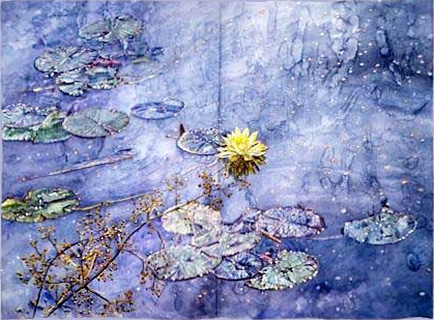 |
Lily Pond, Lannis, Restoration, 1993 Watercolor on paper, 64 ½ x 88 ¾ in. (163.8 x 225.4 cm) Private Collection |
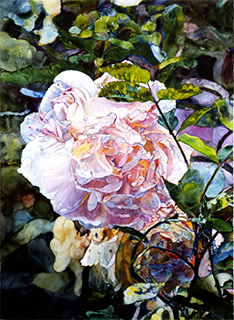 |
Roses Reverie, 2003 Watercolor on paper, 26 x 40 ½ in. (66 x 102.9 cm) Private Collection |
In a Raffael, what you can find, independent of the imagery, are a myriad of short darting unforeseeable strokes and stroke-clusters that certify: This is a Raffael, accept no substitute. When, as in the surprising Self-Portrait, 1985 he does not subordinate this welter-thicket of “DNA”-like free marks to the image, but lets them roam the picture plane, we begin to understand how complex Raffael’s take on reality actually is, how un-PollyAnna-ish his dead serious effort to find images that will heal and transcend. He is in fact more Pollock than PollyAnna.
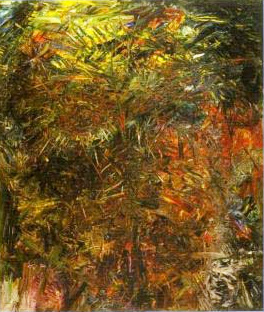 |
Self Portrait, 1985 Oil on canvas, 84 x 72 ½ in. (213.4 x 184.1 cm) |
The Berkeley Art History department, which draws a firm line between itself and the art practice teachers, one fine summer Quarter decided to offer a special collegium involving scholars from far and wide. The guy from Gronigen for example was celebrated for cutting Rembrandt’s oeuvre to the bone. This was to wonder at, from my point of view. If R. didn’t paint The Polish Rider, who the hell from his milieu could have? Anyway I was brought in from the fastness of Pilot Hill to teach the course in the history of art criticism; a specialty offering that had been inaugurated 2 years before by my dear friend Dore Ashton, and given just the prior year by my dear friend Brian O’Doherty. Then my turn. In our circle this succession was fondly known as the greatest anticlimax since Wm. F. Buckley’s God and Man at Yale. Raffael was brought in to teach painting that Quarter, and in the Fall we were to go up to Sacramento together, where I had assumed the role of Chairman. We didn’t have to wait that long to meet. In fact our mutual students insisted we get to know each other. It was a helicopter/Blue Meanie time of student/faculty solidarity. Prompted by the students, Joseph and I arranged to meet at his house in Point Richmond for an early dinner this coming Sunday. The Code is dead/ long live the Code! Point Richmond is a sort of petite-Berkeley village folded smoothly onto hilly narrow winding roads which afford marine-industrial views that are at once intimate and large in scope. Point Richmond has charm, Point Richmond has character. On an end of road lot too small for his concept the U.C. Berkeley artist David Simpson plastered an albumen white pseudo-Venetian arcaded villa which, raw and gauche, distorted the entire raison d’etre of Point Richmond. The reader has heard the expression “there goes the neighborhood…..” Away on sabbatical for a while, Simpson had rented his house to an unsuspecting Joseph Raffael. Unsuspecting what? Read on. The guy that rang the doorbell was in linen trousers over sockless Birkenstocks, with a shirt-tails out dress shirt more or less dripping “love beads”. The man who opened the door was likewise in sandals with white duck pants topped by a loose-fitting V-necked pullover, very suitable for pirate-ship wear, I would have to admit, and similarly festooned with “love bead” strands. Joseph’s hair was not so long by 1969 standards, but it was nonetheless too long. My hair was longer. This threshold sight of the other provoked both host and guest into wearing size XL grins. The evening that followed went just fine-altho’ I noticed a little eyebrow-elevation when I told Joseph I thought I’d seen him the day of the Yale-Army game almost 15 years back. There was also the matter of the contract. Joseph, as the renter, had to sign; promising to pay 50 cents for each paint-chip; so much for a rug stain; yea-much for broken or disappeared table and glassware. From the large hard-edge paintings hung about the house (they are pretty good and bring to mind words like trapezium and cissoid). Raffael might have anticipated a problem. He didn’t so now he was a little on edge as he tried to keep an eye on the elder F.G. children as they zoomed around the house giving the place a test. I conducted an inner debate. Here was a guy, Simpson, who spoiled the tenor of a settled community. And now he wants to charge you for the dishcloth that got wrecked in the dryer. Should I just let it go, not my business. Or should I reach inside my billowing shirt, pull out a cigarette, smoke same, and then grind it out on the hardwood floor? I was mighty piqued. The second course was clearly the better. And I would have followed it right there, reader, not taking into account what my host’s reaction might be, nor even whether Simpson’s neuroses over stains or dirt tracked-in from the garden might not relate to his meticulous paintings. But I stopped short, reader, and advised Joseph to laugh it off (and as we say nowadays, move on). Because I realized that I had no cigarettes, nor any matches. Having never smoked, Reader. And never will. Promised my Mother. On that summer evening in Point Richmond, CA. I resolved to help Joseph some other time, in case he should need help. Perhaps this is that occasion. Perhaps not. At any rate such help as I can offer J.R. will not amount to that much compared to the help he and his work have offered me all these years. Bruce Nauman is right: Remember? The true artist helps the world by REVEALING MYSTIC TRUTHS. For the purposes of our argument here the true artist is likely to be a Romantic like Raffael rather than a geometer, a Neoclassicist, on the order of a David Simpson. For Shelley, unheard sounds were sweeter. In Coleridge’s theory Truth was a “Divine ventriloquist”, speaking thru whoever was handy, such as a boy from Brooklyn. All theories of artistic Inspiration, of the artist taken out of himself, made use of as a medium for Divine Wisdom, all such theories (Plato’s Ion, for instance) would be a prete a porter fit for Joseph Raffael.
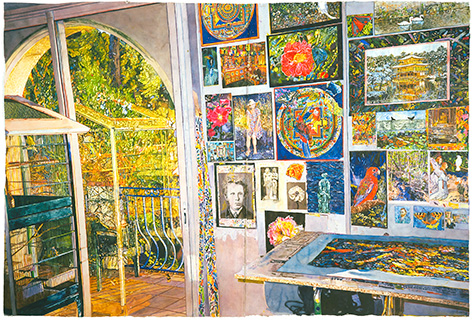 |
Biography Interior-Exterior,
Exterior-Interior, 2003 Watercolor on paper, 54 ½ x 81 in. (138.4 x 205.7 cm) Nancy Hoffman Gallery, New York |
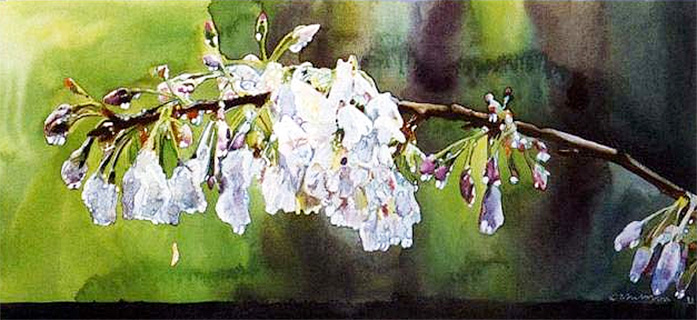 |
Matthew's Branch, 1981 Watercolor on paper, 14 x 30 in. (35.5 x 76.1 cm) Joseph & Lannis Raffael |
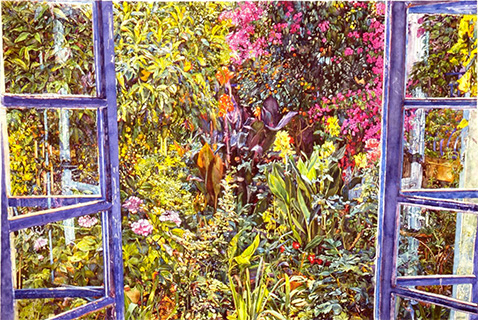 |
The Open Window, 2001 Watercolor on paper, 60 x 89 in. (152.4 x 226 cm) Private Collection |
“Tu es belle”
Le Grand Meaulnes is a first novel by Henri Alain-Fournier, killed in WW1. It’s about True Love at first sight, it’s about preservation of the innocent eye, and the uncontaminated outlook of childhood, it’s about many things. The principal episode takes place at a remote (country) Chateau while a fete for the children is in swing. The kids make all the rules; boat races, games, pony rides are the order of the day; clowns abound, there is music and the foods that kids like best. Under these circumstances, Boy meets Girl. At bottom, my work is about recovering the freedom of pure play which when we grew up, we gave up. Raffael understood this. And right away he made our isolated country house for the fictional Chateau. So hard to remember which turns to follow, so easy to get lost even when you have good directions. Several of Joseph’s very fine early paintings are painted in response to the call of this very special novel of character-formation. Meaulnes immediately took its place in the roster of French literature which so often pits honor, duty, responsibility against a dream world of Love and pleasure. Guess who’s read Le Grand Meaulnes more times, J.R. or J.F.G? Go ahead, guess. This one’s on me. You are quite wrong! Joseph has the edge, 6 times to 5. Not only that,he finished the book in French, whereas I quit after the fete scene at the chateau. This is especially creditable on J.R.’s part because ever since I misinformed the readers in my Pilot Hill catalog to the effect that Joseph was not much of a reader at all, some people have assumed that J.R. has to sound out the words. I thought I remembered his telling me he’d seen the film, read the subtitles. Not so, I take it back. Joseph reads, reader. All the time. If you hired him he would read on the job and you’d have to fire Joseph. Joseph used to read in Department meetings. So did I. If he comes to my funeral Joseph probably will stand at the back with the tall people and read. What’s irksome to me in this book/film question is not that Joseph is right (for surely he is and welcome). What irks me is that my memory very evidently failed. That worries me. The best medical speculation has it that, in my youth, I attended too many art openings, the kind of activity that over a long period accumulates and only makes itself felt as you draw near threescore and tten. Then it hits you with memory loss, double vision, and God-knows. The gist of it is you can’t remember whether or not you took your pills.
“ But grant for a moment, that there is a realm beyond the senses….”
Rilke, Letters,1915 Anyway, good people, Raffael is in fact a reader like you and me. He’s a pretty clear writer as well. Not all painters are. Just the other month J.R. recommended the latest Philip Sherrard book on the place of the Sacred in a world blasted from within, our world. It’s a useful volume to have in hand as you approach Joseph territory. I always get around to saying this, here it is: If there is no meta-realm; if the Supernatural does not exist; if the Spiritual plane is a locus spurious; if the Divine itself is no more than a wishfulfilling self deception; if all these Ifs, then J.R.’s paintings (and everyone else’s) amount to no more than quite expensive wall-coverings. But this is America, patriotic reader, and-so they tell us- we are a religious nation and there is a whole movement, the Hudson River boys, who see the hand of the Creator in every leaf and waterfall and beehive. The first and probably the best of this bunch is Thomas Cole, who peopled the upper reaches of his enormous landscape-canvases with see-through figures of God the Father and his retinue. One of the last of ‘em George Inness, a Swedenborgian transcendentalist, painted trees that seem unanchored to terra firma; they yearn heavenward; like Cole a great colorist, Inness held conferences with angelic presences. And a moralizing genre painter of Cole’s vintage, Wm. Sidney Mount, went everyone one better by conducting an epistolary correspondence with Rembrandt which we are most thankful to have, given that there are barely a handful of van Rijn letters, most of which deal with the rent-money, stuff like that. In our own day and place, Steve Kaltenbach has usually kept at least one foot in the metaphysical; the portrait of Steve’s Father on his deathbed is a striking instance of how Photo-realism can be adapted to suggest an otherworldly Presence. But in the long history of American art from Cole and Church and Bierstadt all the way down to Ed Carrillo, Nathan Oliveira, and Kaltenbach perhaps no painter has staked so much on the Reality of the meta-world as Joseph Raffael. As I write, there is an heroic stand-off in the Butler Museum of American Art between the greatest, most spiritual painting I’ve ever seen by Julian Stanczak and J.R.’s giant Papermill Creek. The two painters were classmates under Albers. Julian Stanczak wasn’t then, and isn’t now, any match for Joseph. The J.R., so to speak, simply OVERWHELMS him. J.R., of course, wouldn’t see this confrontation in the Museum in terms of a test.
In a general way, anyhow, Joseph thinks most student on student influences are superficial. He does retain one friend from Albers-days, Richard Ziemann who has been quietly making his art all these years in back-state Connecticut; the two men are still in touch.
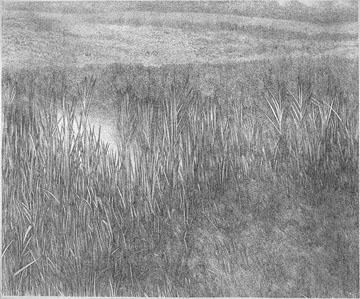 |
Wetland II,1998-99 etching & engraving, 9 7/8 x 11 7/8" Richard Ziemann. Jane Haslem Gallery Washington, DC |
There was a student who influenced Joe Raffaele, reader; we know him now as Joseph Raffael. From at least as early as his artist-statement for the 1967 Sao Paolo Biennale, J.R. has stressed the need to get inside yourself; the artist should withdraw within. Essentially he would agree with Pindar who in Edith Hamilton’s paraphrasing, feels that “The educated man is a twilight man; true merit comes from in-born glory”. Arthur Schopenhauer is on the same train of thought Acquired characteristics are dismissable. He praises the Brahmin philosophers who “express the unalterable fixity of innate character in a mystical fashion.” This opens the door not merely to Plato and the doctrine of innate Ideas, but to Calvinism and to St. Paul; in other words to predestination. Teddy Atlas, J.R’s homeboy sez: You can teach a boxer fancy footwork and to stick a jab, but big punchers are born not made. Every real value is metaphysical, a priori, and lies innate; and the source of real power is not a mere phenomenon but is established once and for all as the very thing-in-itself, das Ding an sich. “Experience”, Schopenhauer adds, “teaches the same lesson to all who can look below the surface.” And should you look beneath the surface, dear reader, you are certainly going to see those Raffael Koi. Genius is such a hard word to feel comfortable using; so is Masterpiece. But those are the very words one must fall back on when dealing with J.R., or not deal with him at all. Nor is it at all explicable how he can be getting better. I think metaphorically of J.R. traveling pure North. (Not always, but) generally speaking, the further North you get the higher quality the Indian basket, the tighter the weave, the subtler the color. That is where Joseph is right now. He’s tightening the weave and looking at his compass to see when he will run out of North.
This essay is reprinted with permission of the author.