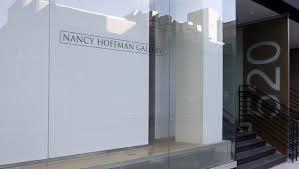



Poetic Reveries: The Paintings of Joseph Raffael
March 3 – April 16, 2006
Opening Reception, Sat. March 4, 2006
Questions for Joseph Raffael
1. You attended Yale. Did they prepare you for a life as a gainfully self-employed artist? What would you have changed had you been in charge of the department?
In the sense that I learned much there from Josef Albers, Bernard Chaet, and the physical set-up gave me the opportunity to paint in a studio space whenever I wanted to; it was open 24 hours a day, 7 days a week. It was there I learned how to be an artist alone and the necessity to self discipline.
2. Who inspires your work, or who has influenced you (or still influences)? Does poetry or music offer any musings?
I would say that Nature is a prime source of inspiration for me: the garden, the view of the ever-changing sea out my studio window, the luminescent skies,
the fish in the ponds, our birds and the wild birds, our dogs and cats ---all that is nature, including the sun, the moon reflected on the sea or in its Alfred Ryder skies,the dawns and crepuscular moments in the sky.
Lannis, my wife is definitely my muse, and I learn from her each moment we’re together. She has helped my ‘artist’ more than anyone ever; she has created an environment for me to make the art in. I share my art with her throughout the process of its realization.
Poetry, Music, Films and Literature feed and touch my soul.
3. Why did you move to France?
The career aspect of being an artist in the art- world was encroaching upon me, and getting in the way of my original artist self.
Also many of the artists I had long admired and had been inspired by had lived
and worked in France.
I had long had the dream of being an artist working in France.
I needed to retrieve my ‘original’ artist, the person who drew as a child and loved that activity more than anything.
4. Why watercolor? Is permanence an issue?
I used to paint in oil mostly. With time I discovered that watercolor had a certain quality which fascinated me --- how when it was wet it was a certain color and when it dried it was another. These changes could not be predicted. This characteristic was a way of forcing me to get out of the way and let the painting in a sense paint itself, or at least to reveal itself on the paper in a way which I could not have forseen.
Little by little, I painted more and more in that medium. I never think of these works as ‘water-colors’, but rather as paintings. I am painting not doing a watercolor.
I do use permanent colors, and when the pieces are framed there is a special glass which protects the colors from ultra-violet rays..
5.In other interviews you’ve talked about the use of photography as a tool. In his defense on the artistic merits of the 15th century Flemish artists who did not use optics, Stanford University’s David Stork referred to such tools as “cheating”. In purist circles using optics has been a huge no-no, like using opaque white. What’s your feeling on this?
I haven’t followed the rules and limitations imposed by ‘rule-makers’.
I barely noticed them. Photography has always been an absolutely natural element in my creative process.
See Jean-Claude Lebensteijn essay: josephraffael.com
Making pictures comes to an individual the way it does.
If Pollock had followed the ‘rules’ where would his history-changing drip paintings be today?
6. Picasso once said that he would trade all of Italian Renaissance art for one Vermeer. (Obviously he didn’t know your work.) Is there a perfect painting you’ve painted, or done by another artist you, too, admire?
Many artists throughout time have painted works of perfection. They are inspiring.
7. You’ve written about the act of painting as self-discovery. Is there more to painting than self-discovery?
Certainly. There is in the act of painting an alchemical activity during which the painting reveals itself. It appears as out of nowhere. What wasn’t there ever before appears. Having studied with Abstract Expressionists James Brooks and John Ferren during A-E’s heyday in the mid/ late 50’s in New York, I learned this ‘out of nothing something appears’ way of approaching the making of a picture.
Painting reveals the invisible – that which is waiting on the sidelines of consciousness to manifest itself. For me, in this way, the creative arts are sacred rituals. The person helps birth new never-seen before, precious life.
8. What has been the most difficult painting you’ve executed? Do you push yourself toward a degree of difficulty? Or toward more experimentation?
Every painting I undertake is the most difficult painting I’ve ever done.
I go through a hellish doubt and pain in each one.
About ¾’s of the way through, when the painting has established it’s own way of wanting and needing to be painted, and it is there in front of me, appears something that I could never have imagined, I then can let go of efforting and let, as it were, the painting paints itself through me.
9. Why the borders?
I love the borders. How they lovingly enclose, protectively elucidating the central inner image. The two unite becoming partners in a kind of marriage.
One is an image of ‘art’ and the other an image of ‘nature’.
10. Talk about the scale of your paintings. Why monumental?
They aren’t all monumental in size. The image decides the size.
11. Your paintings seem to consistently possess the power to leave the viewer with a profound after-image willing to penetrate the recesses of the soul.
I am happy to hear you express this. One of my joys about being an artist is that
I do believe it is ‘soul-work’ and that Art -- certain Literature, Paintings,
Sculpture, Music, Cinéma, etc. can and do touch people’s beings and souls.
12. When I met you and Lannis around six years ago, I left with an extraordinary after-image of grace and humility that seemed to enrobe you. And after reading your CV and all your accomplishments, what carries you into such a sanctuary of humility?
I’ve painted paintings for more than five decades and I know as sure as I’m expressing these words in this very moment that it isn’t the ‘me’ who has created the work. It’s been a collective effort with Creative Spirit. When that fearless guest Creative Spirit enters and we collaborate with it, there is an alchemical shift. I believe that is what is known as ‘The Creative Moment’.
13. Knowing that venturing into the world of life as a painter means many hours alone in the painting process, how do you self-critique? What guidelines or criteria do you employ?
Rilke said the only thing which could see and understand a work of art was love in the beholder.
My ‘critic’ within my head is someone I have been discouraging forever. For me it is not an ally of the creative process. The ‘knowing, the learning, the perceiving’ in the making of art comes with time, experience and with the doing and doing and doing, and being open and explorative. It is a long process.
14. We talked at the Nancy Hoffman Gallery before about your routine. Describe to our students what that is for you, how you established it, and the merits of discipline, and what gives you perspective to continue.
I work in the studio 6 days a week most of the year. I begin around 10 AM each day with a break for lunch and a short nap, and then an afternoon/early evening of painting, finishing up around 7 PM.
I learned early on that without ‘doing’ it doesn’t get done.
The telling lesson was the following: One evening when I lived in NewYork as a young artist the photographer Peter Hujar and the writer Linda Rosenkrantz asked me to go to Times Square with them to walk around and view the scene. I had wanted to draw that evening so I declined. Off they went. It was a great evening for them. I believe Peter took some extraordinary photographs. They had a good, productive time. While they were gone, in the quiet of the apartment I made a drawing with a flowmaster pen of a many leafed plant. A few hours later they returned and their time had been positive. Mine too. I had helped that drawing come through, and I knew that that drawing could only have come forth in the specific moments of that evening. The next day it would not have been available; a different drawing would have happened.
Krishnamurti says’ you can’t repeat a truth’. And I feel that inspiration is like air --- you don’t and can’t breathe the same air twice. What will be painted through my brush this afternoon could not have been painted this morning, and vice-versa.
All this to say that time in the studio in front of the painting is essential.
Discipline is everything.
“What gives me perspective to continue?”
I continue because this is what I do every day.This is my life. There is nothing else I would care to do.
Rilke again, in his “Letters to a Young Poet”:
“In the darkest hour of your night ask yourself if you could live without writing (painting)…….”
I asked that question to myself when I was twenty, and I’ve been ‘continuing’ ever since.
------Joseph Raffael -----
Antibes, France
14-15 February 2006
Kathrine Page
Director, Davison Gallery
Roberts Wesleyan College
2301 Westside Dr.
Rochester, NY 14624-1997
Page_Kathrine(at)roberts.edu